
February 17, 2026 | SNAK Consultancy
Share on :
How to Select the Best AI Automation Tools for Business Growth
Introduction
In today’s hyper-competitive digital landscape, AI automation tools for business growth are no longer optional — they are essential. From automating repetitive workflows to improving decision-making with predictive analytics, AI-powered automation is transforming how businesses scale, reduce costs, and increase productivity.
However, with hundreds of AI business automation tools available in the market, choosing the right one can feel overwhelming.
This comprehensive guide will help you understand how to select the best AI automation tools for your business, ensuring maximum ROI, scalability, and long-term growth.
Why AI Automation Tools Are Critical for Business Growth
Before selecting a tool, it’s important to understand why AI-driven automation solutions matter.
Businesses today use AI automation software to:
1. Automate repetitive business processes
2. Improve operational efficiency
3. Enhance customer experience
4. Reduce human errors
5. Increase productivity
6. Enable data-driven decision making
7. Scale operations without increasing costs
Companies leveraging intelligent automation tools see faster turnaround times, improved accuracy, and better resource allocation.
Step 1: Identify Your Business Automation Needs
The first step in selecting the best AI automation tool is understanding your goals.
Ask yourself:
1. Do you need marketing automation tools powered by AI?
2. Are you looking for AI workflow automation software?
3. Do you need AI tools for sales automation?
4. Is your goal customer service automation using AI chatbots?
5. Are you automating internal operations like HR, finance, or supply chain?
Clearly defining your use case helps narrow down the right AI automation platform.
Step 2: Evaluate Core Features of AI Automation Tools
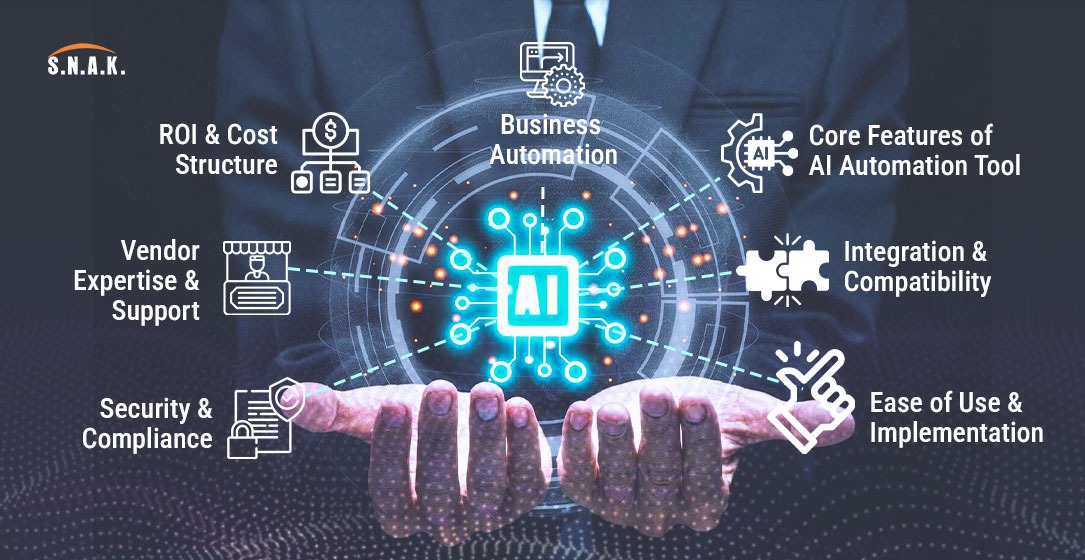
Not all AI automation software is built the same. The best AI automation tools for business growth should offer:
1. Machine Learning Capabilities
The system should improve over time using data.
2. Workflow Automation
Ability to automate multi-step business processes.
3. Data Integration
Seamless integration with CRM, ERP, cloud platforms, and third-party applications.
4. Real-Time Analytics & Reporting
Actionable insights and dashboards for decision-making.
5. Scalability
The solution should grow with your business.
6. Customization Options
Every business is unique. Flexible automation rules are essential.
Step 3: Check Integration & Compatibility
One of the biggest mistakes businesses make is choosing an AI automation tool that doesn’t integrate well.
Ensure your AI-powered business automation tool integrates with:
1. CRM platforms
2. ERP systems
3. Cloud infrastructure
4. Marketing platforms
5. Data analytics tools
Poor integration increases operational silos and reduces automation effectiveness.
Step 4: Consider Ease of Use & Implementation
The best AI tools for business automation should be:
1. User-friendly
2. Low-code or no-code (if possible)
3. Easy to deploy
4. Supported by strong documentation
Complicated automation software increases training time and slows ROI.
Step 5: Assess Security & Compliance
AI automation platforms handle sensitive business data. Always verify:
1. Data encryption standards
2. Role-based access control
3. Industry compliance (GDPR, ISO, etc.)
4. Cloud security certifications
Security is non-negotiable when selecting AI business automation software.
Step 6: Evaluate Vendor Expertise & Support
Choosing the right AI automation solution provider is as important as the tool itself.
Look for:
1. Proven experience in AI implementation
2. Industry-specific case studies
3. 24/7 technical support
4. Custom AI automation development capabilities
A reliable AI partner ensures smooth deployment and continuous optimization.
Step 7: Calculate ROI & Cost Structure
When evaluating AI automation tools, consider:
1. Subscription vs one-time cost
2. Implementation charges
3. Customization cost
4. Maintenance & upgrade fees
5. Expected productivity improvement
The best AI automation software should deliver measurable ROI within months.
Key Types of AI Automation Tools for Business Growth
To simplify selection, here are common categories of AI business automation tools:
Marketing Automation AI Tools
1. Lead scoring
2. Email automation
3. Campaign optimization
Sales Automation Tools
1. AI CRM automation
2. Predictive sales forecasting
3. Proposal automation
Customer Support AI Tools
1. AI chatbots
2. Automated ticketing systems
3. Sentiment analysis
Operational AI Automation
1. HR onboarding automation
2. Invoice processing automation
3. Supply chain AI optimization
Data & Analytics Automation
1. Predictive analytics
2. Automated dashboards
3. Real-time business intelligence
Common Mistakes to Avoid When Selecting AI Automation Tools
1. Choosing tools without a clear automation strategy
2. Ignoring integration capabilities
3. Underestimating training requirements
4. Selecting tools without scalability
5. Focusing only on price instead of ROI
Avoiding these mistakes ensures successful AI automation implementation.
Benefits of Choosing the Right AI Automation Tools
When implemented correctly, AI automation tools help businesses:
✔ Increase operational efficiency
✔ Reduce manual workload
✔ Improve accuracy and compliance
✔ Accelerate digital transformation
✔ Enhance customer experience
✔ Scale faster with lower operational costs
AI-powered automation is not just about cost savings — it’s about sustainable business growth.
Questionnaire
1. What are the best AI automation tools for small businesses?
Ans. The best AI automation tools for small businesses are scalable, affordable, and easy to implement. Look for no-code AI workflow automation tools that integrate with CRM and accounting software.
2. How do AI automation tools improve business productivity?
Ans. AI automation tools eliminate repetitive tasks, reduce errors, and allow teams to focus on strategic work. This improves efficiency and overall business productivity.
3. What industries benefit most from AI automation?
Ans. Industries such as manufacturing, retail, healthcare, finance, and IT services benefit significantly from AI-powered business automation solutions.
4. Is AI automation expensive for growing companies?
Ans. AI automation software comes in various pricing models. Many cloud-based AI automation tools offer scalable pricing suitable for startups and enterprises alike.
5. How long does it take to implement AI automation tools?
Ans. Implementation time depends on complexity. Basic AI workflow automation can be deployed in weeks, while enterprise-level intelligent automation may take several months.
Conclusion
Selecting the best AI automation tools for business growth requires strategic evaluation, technical assessment, and long-term planning. The right AI-powered automation solution can streamline operations, reduce costs, and accelerate digital transformation.
Businesses that invest in the right AI automation software today position themselves for sustainable growth tomorrow.