
October 13, 2026 | SNAK Consultancy
Share on :
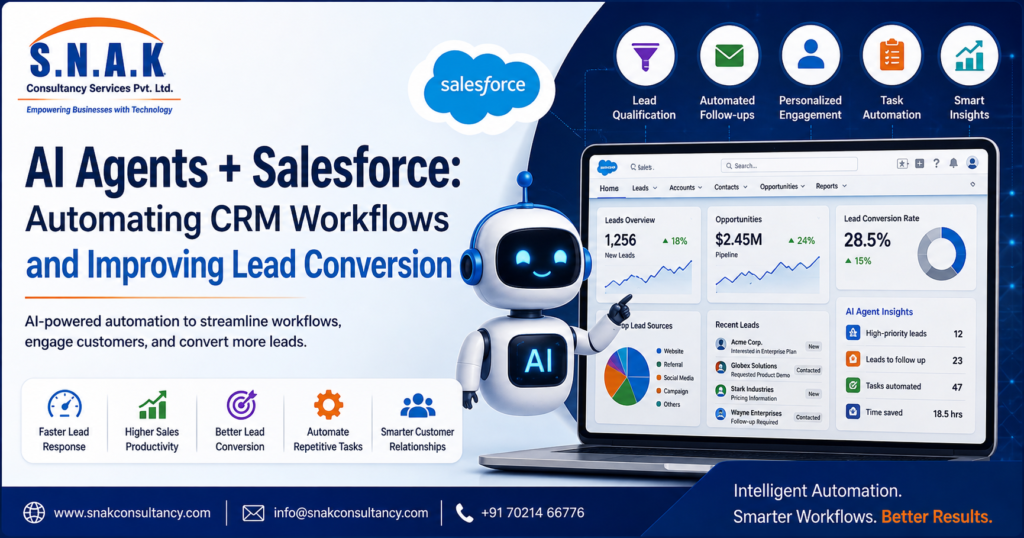
AI Agents + Salesforce: Automating CRM Workflows and Improving Lead Conversion
Introduction
Businesses need more than a traditional Customer Relationship Management (CRM) system to stay competitive. They need faster workflows, better customer insights, and smarter sales processes. This is where AI Agents and Salesforce can make a difference.
AI agents help businesses automate tasks, analyze customer information, and support sales teams. When integrated with Salesforce, they can help manage leads, improve customer engagement, and streamline daily CRM activities.
For example, an AI agent can identify a new lead, analyze its information, and recommend the next action. It can also help sales representatives prioritize prospects and follow up at the right time.
As a result, businesses can reduce manual work and focus on meaningful customer interactions. At SNAK Consultancy Services Pvt. Ltd., we help businesses explore AI, Salesforce integration, and intelligent automation to improve operational efficiency and support business growth.
What Are AI Agents in Salesforce?
AI agents are intelligent software systems that can understand goals, process information, and perform tasks within defined permissions. They can use connected business systems and follow workflows to complete specific activities.
Salesforce provides CRM capabilities for managing customer relationships, sales pipelines, marketing activities, and
customer service. AI agents can extend these capabilities by helping teams automate tasks and act on CRM data.
For example, a sales team may receive hundreds of leads every week. Reviewing every lead manually can take time. An AI agent can analyze available lead information, identify promising prospects, and suggest which leads need immediate attention.
Key capabilities of AI agents in Salesforce include:
1. Lead qualification and prioritization
2. Automated follow-up support
3. Customer interaction summaries
4. CRM data analysis and insights
5. Sales workflow automation
6. Personalized customer engagement
7. Task recommendations for sales teams
The level of automation depends on the Salesforce configuration, connected data, permissions, and business rules.
7 Ways AI Agents + Salesforce Can Improve Lead Conversion
1. Automate Lead Qualification
Lead qualification helps sales teams identify prospects who are more likely to become customers. However, manual qualification can slow down the sales process.
AI agents can analyze available information, such as lead source, industry, company size, engagement history, and previous interactions. They can then help score leads based on predefined criteria.
This allows sales representatives to focus on high-priority prospects.
Business benefits:
1. Faster lead evaluation
2. Better sales prioritization
3. Less manual research
4. More efficient use of sales resources
2. Improve Lead Follow-Ups
Timely follow-ups are essential for successful lead generation. When sales representatives manage many prospects, some follow-ups may be delayed or missed.
AI agents can monitor CRM activities and identify leads that need attention. They can recommend the next step, prepare personalized messages, or initiate approved workflows.
For example, an agent can flag a prospect who requested a product demo but has not received a follow-up.
As a result, sales teams can respond faster and maintain consistent communication.
3. Personalize Customer Communication
Every customer has different needs, interests, and expectations. Generic messages may not create enough interest to move a prospect forward.
AI agents can use relevant Salesforce records and approved customer information to help personalize communication.
They can consider a prospect's industry, previous interactions, product interests, and position in the sales pipeline.
This helps businesses deliver more relevant messages at the right stage of the customer journey.
However, customer data must be handled according to applicable privacy requirements and organizational policies.
4. Automate Repetitive CRM Tasks
Sales representatives often spend valuable time updating records, creating tasks, preparing summaries, and entering information.
AI agents can help automate these repetitive activities through connected Salesforce workflows.
For example, an agent may summarize a customer interaction and prepare a draft CRM update. Depending on the configured permissions, the update may be completed automatically or sent to a representative for approval.
This reduces administrative work and gives sales teams more time to engage with customers.
5. Gain Better Sales Insights
Salesforce stores valuable information about leads, accounts, opportunities, and customer interactions. Yet, teams may struggle to turn large amounts of data into useful decisions.
AI agents can help analyze CRM information and highlight important patterns.
For example, they may identify opportunities with no recent activity, leads with declining engagement, or deals that require additional attention.
These insights help sales managers understand pipeline performance and make informed decisions.
6. Streamline Sales Pipeline Management
A well-managed sales pipeline helps businesses track opportunities from initial contact to deal closure.
AI agents can monitor opportunity records and identify missing information, overdue activities, or deals that may need intervention.
They can also recommend next steps based on defined sales processes.
For instance, an agent may alert a sales manager when an important opportunity has remained inactive for several days.
This improves pipeline visibility and helps teams manage opportunities more effectively.
7. Support Faster Customer Responses
Customers expect quick and relevant answers to their questions. Delayed responses can affect customer satisfaction and sales opportunities.
AI agents can help answer routine questions, retrieve approved information, and direct complex requests to the right team.
When connected to Salesforce, they can use relevant customer records to support more contextual interactions.
Human representatives can then focus on complex discussions, negotiations, and relationship building.
AI Agents vs. Traditional Salesforce Automation
Salesforce already offers workflow automation features. AI agents can complement these tools by supporting more context-aware tasks and decisions.
Feature |
Traditional CRM Automation |
AI Agents + Salesforce |
| Task execution | Follows predefined rules | Can interpret context within defined boundaries |
| Lead management | Applies configured criteria | Can analyze available signals and recommend priorities |
| Customer communication | Uses predefined templates | Can help create contextual responses |
| Decision support | Executes fixed workflows | Can evaluate information and suggest next steps |
| Complex tasks | Often requires multiple configured rules | Can coordinate connected tools and workflows when supported |
| Human involvement | Depends on workflow design | Can escalate decisions or request approval |
Both approaches have value. Traditional automation is useful for predictable, rule-based tasks. AI agents are useful when workflows benefit from contextual analysis and flexible task coordination.
How AI Agents and Salesforce Integration Work Together
Successful implementation requires more than connecting an AI model to a CRM. Businesses need the right data, integrations, permissions, and workflows.
Here is a simplified implementation process.
Step 1: Identify business goals
Define the challenges you want to solve. These may include slow lead response, manual data entry, or poor pipeline visibility.
Step 2: Review Salesforce data
Check the quality of lead records, customer information, opportunity data, and existing workflows.
Step 3: Select suitable AI use cases
Start with a focused use case, such as lead prioritization, interaction summaries, or follow-up recommendations.
Step 4: Integrate AI agents with Salesforce
Configure the required APIs, connected services, CRM objects, and automation workflows.
Step 5: Establish security and approvals
Define access permissions, data protection measures, escalation rules, and human approval requirements.
Step 6: Test and measure performance
Run a pilot and compare results against the existing process. Expand the solution only when it delivers measurable value.
Key Benefits for Businesses
Combining AI agents with Salesforce can help organizations improve sales operations and customer relationship management.
The key benefits include:
1. Higher productivity: Reduce repetitive CRM tasks.
2. Faster lead response: Identify prospects that need attention.
3. Improved sales visibility: Highlight pipeline risks and opportunities.
4. Better customer experiences: Support relevant and timely interactions.
5. Consistent workflows: Apply business rules across sales processes.
6. Data-driven decisions: Turn CRM information into actionable insights.
7. Scalable operations: Support growing lead volumes with structured automation.
Actual results depend on data quality, implementation, adoption, and the selected use cases. Businesses should measure performance rather than assume a specific improvement in conversion rates.
How to Measure the ROI of AI Agents + Salesforce
Before scaling an AI agent solution, businesses should define clear performance indicators.
The following metrics can help measure its business value.
| KPI | What It Measures |
| Lead response time | How quickly the sales team responds to new leads |
| Lead-to-opportunity rate | The percentage of leads that become sales opportunities |
| Lead conversion rate | The percentage of leads that become customers, based on a defined measurement |
| Sales productivity | Time spent on selling versus administrative work |
| Follow-up completion rate | The percentage of required follow-ups completed on time |
| Sales cycle length | The time required to move from initial engagement to a closed deal |
| Cost per qualified lead | The cost of generating a qualified prospect |
Compare these metrics before and after implementation. This helps identify which workflows deliver measurable value and where further improvements are needed.
Why Choose SNAK Consultancy Services for Salesforce and AI Integration?
Businesses need technology solutions that align with their processes, customer expectations, and growth goals.
SNAK Consultancy Services Pvt. Ltd. helps businesses explore enterprise technology solutions across Salesforce, AI, data analytics, and cloud platforms.
Our technology-focused approach can support organizations looking to improve CRM workflows, connect business systems, and make better use of enterprise data.
With the right implementation strategy, businesses can explore opportunities to:
1. Integrate Salesforce with existing business applications.
2. Automate repetitive CRM workflows.
3. Improve lead management and sales visibility.
4. Use AI to support customer interactions.
5. Connect enterprise data for better decision-making.
6. Build scalable solutions aligned with business requirements.
The right solution starts with understanding your current processes and identifying the areas where AI can create practical business value.
Explore our Salesforce Solutions to learn more.
Questionnaire
Ques1. What are AI agents in Salesforce?
Ans. AI agents in Salesforce are intelligent systems that can analyze CRM information, assist with sales tasks, recommend actions, and automate approved workflows based on configured permissions.
Ques 2. How can AI agents improve lead conversion?
Ans. AI agents can help prioritize leads, support timely follow-ups, personalize communication, and identify prospects that need attention. These capabilities can improve sales efficiency and support better conversion outcomes.
Ques 3. Can AI agents automate Salesforce workflows?
Ans. Yes. AI agents can support Salesforce workflow automation, including lead management, task creation, customer interaction summaries, and follow-up recommendations. Available capabilities depend on the implementation.
Ques 4. Are AI agents suitable for small and medium-sized businesses?
Ans. Yes. Small and medium-sized businesses can start with focused use cases, such as lead prioritization or follow-up reminders, and expand as their needs and resources grow.
Ques 5. How can SNAK help with Salesforce and AI integration?
Ans. SNAK Consultancy Services offers Salesforce-focused technology solutions. Businesses can discuss their CRM integration, workflow automation, and AI requirements to identify a suitable implementation approach.
Conclusion
AI agents and Salesforce offer businesses new ways to improve CRM automation, sales productivity, and lead management. They can help teams qualify leads, support timely follow-ups, analyze pipeline data, and reduce repetitive work.
However, successful adoption requires clear goals, reliable data, secure integrations, and continuous performance measurement.
Businesses that start with focused use cases can identify practical opportunities before expanding AI across their operations.
Ready to make your CRM workflows more intelligent?
Connect with SNAK Consultancy Services Pvt. Ltd. to explore Salesforce integration and AI-powered business solutions.
Book your FREE IT Consultation today.
Visit: www.snakconsultancy.com